

How to Calculate Customs Duty When Importing from China: A 2026 Guide
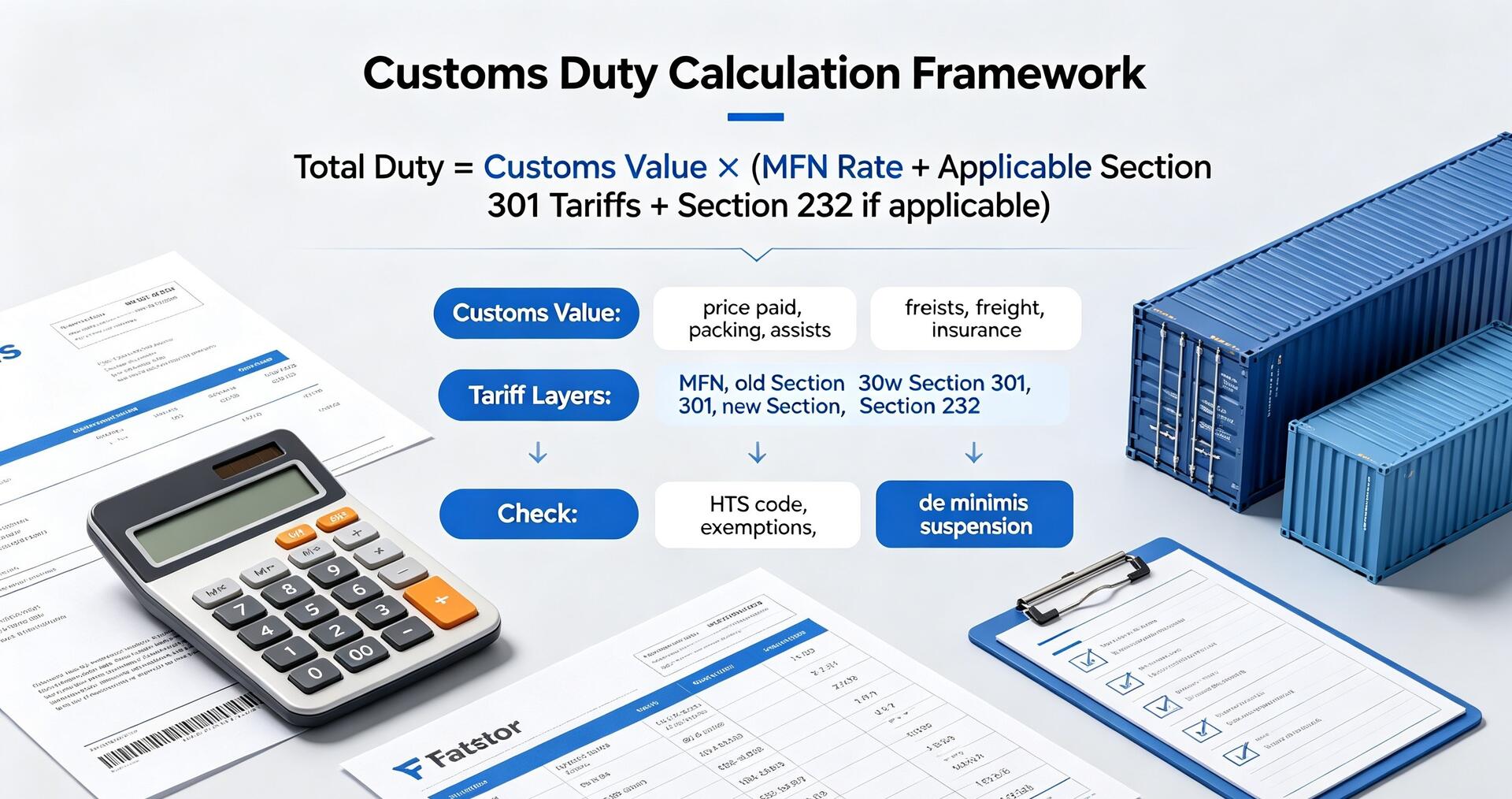
This framework is adapted from <a href="https://www.transworldcn.com/About-us/">TransWorld</a> and retains the source guide's step-by-step approach. Its policy dates, tariff figures and valuation assumptions are source-reported references, not an independently verified customs ruling. Confirm the measures in force for the product and entry date with a licensed customs broker before filing or using the figures for a binding landed-cost estimate.
Step 1: Identify the U.S. HTS Code
The guide starts with the complete 10-digit U.S. Harmonized Tariff Schedule code rather than a supplier's Chinese code alone. The first six HS digits are internationally standardized; additional digits provide the destination's further classification.
Its roasted-coffee example breaks the structure into four levels: chapter 09 covers coffee, tea and spices; heading 0901 covers coffee; subheading 0901.21 identifies roasted, non-decaffeinated coffee; and the guide assigns 0901.21.0010 to containers of no more than two kilograms. Treat this as the source's example and verify the actual classification before making an entry.
The original resource table identifies the USITC HTS database for official U.S. classifications and rates, Tariff Check for tariff searches, and the Flexport Tariff Simulator for calculations involving Section 301 and Section 232. A search result is not a substitute for checking the product's material, function, specifications and intended use with a broker.
Step 2: Find the Base MFN Rate
After classification, identify the base Most Favored Nation rate, described in the guide as the standard rate for imports from WTO members, including China. The workflow directs readers to Column 1, Normal, in the applicable HTS entry.
Rates can take different forms. An ad valorem duty is a percentage of value, such as 3.2%. A specific duty is an amount per unit, such as US$0.32 per kilogram. A combined rate contains both elements. The source uses woodworking machinery under 8465.92.00 with an approximately 3.2% rate as an illustration; that classification and rate require confirmation for the actual goods.
Step 3: Assess Section 301 Measures
The source guide separates Section 301 into two reported layers. It lists older measures associated with Lists 1-4 at 7.5-25%, varying by product, and describes a further 12.5% forced-labor measure with a July 24, 2026 effective date. It says the latter applies to China, Vietnam and 41 other economies and is additive to the older layer.
These are claims made by the source guide, not verified policy findings in this adaptation. Establish the applicable notice, product coverage, entry date and any exclusion before using either figure.
The guide's illustrative arithmetic combines a 25% older layer with a 12.5% additional layer to obtain 37.5%, before adding MFN duty. For a power adapter labeled 8504.40.85, it assumes MFN of 2.5%, an older Section 301 rate of 25% and a further 12.5%, producing a 40% example total. This is an explanation of the source's assumptions, not a confirmed duty determination for all adapters.
Step 4: Check Section 232 and Other Product Measures
The original product-category comparison lists steel and aluminum at 25% under Section 232, vehicles and parts at up to 25% under its stated Section 301 automotive treatment, and copper at 25% under a Section 232 measure it dates to 2025.
The source also says its additional 12.5% measure does not stack with Section 232, while its later workflow refers more broadly to 25-50% Section 232 duties for metal and automotive goods. These statements need product-specific reconciliation. Do not assume that every listed tariff can simply be added together or that every metal-containing article receives the same treatment.
Step 5: Review Exclusions
The guide reports a November 29, 2026 deadline for certain Section 301 exclusions and names some electronics, components, medical supplies, industrial machinery and solar-manufacturing equipment as examples of relevant categories.
It describes an excluded product as avoiding the Section 301 layer. Confirm the precise exclusion wording, classification, product description, effective period and remaining applicable measures rather than assuming that a broad category label establishes eligibility. The guide directs readers to the current USTR exclusion list.
Step 6: Establish the Customs Value
The source guide cites 19 U.S.C. § 1401a and presents a list of valuation components. It includes the goods' purchase price, packing, commissions described as selling commissions involving a buyer's agent, assists such as buyer-provided materials or tools, royalties that are conditions of sale, and freight and insurance. It excludes advertising costs and the buyer's internal expenses.
The treatment of freight, insurance and commissions is a material assumption in that source list and must be confirmed for a U.S. entry. The list is reproduced here in prose to explain the original framework, not to certify that every listed cost belongs in every transaction value.
The guide warns against false invoices, using one true invoice and another reduced invoice for customs, and omitting required additions. It describes possible consequences including back duties, civil penalties, loss of trusted-trader status and criminal prosecution. Maintain accurate records rather than treating undervaluation as a cost-saving method.
Step 7: Check Low-Value and Postal Treatment
The source reports suspension of the US$800 de minimis exemption from August 29, 2025. It also describes postal charges using three country-tariff bands: US$80 per item below 16%, US$160 at 16-25%, and US$200 above 25%.
Those figures and their period of application require confirmation before use. The guide distinguishes postal items from commercial shipments, for which it says applicable duties must be assessed regardless of value. Do not infer current eligibility, procedure or charges solely from a parcel being worth less than US$800.
Step 8: Calculate the Example Duty
For a shipment subject to compatible ad valorem measures, the source's approach multiplies customs value by the applicable combined rate. Its illustrative expression adds MFN, applicable Section 301 measures and Section 232 where applicable. The non-stacking discussion above means applicability must be checked before combining layers; specific or combined duties also require their relevant units.
The worked power-adapter example assumes a US$10,000 CIF value, which the source treats as customs value including freight and insurance. Under its assumed rates, the calculation is:
MFN: US$10,000 multiplied by 2.5% produces US$250.
Older Section 301 layer: US$10,000 multiplied by 25% produces US$2,500.
Additional layer described by the guide: US$10,000 multiplied by 12.5% produces US$1,250.
Illustrative total: US$4,000, equivalent to 40% of the assumed value.
The arithmetic follows those inputs. It does not independently establish the correct classification, dutiable value, effective tariff measures or payable amount for a real shipment.
Avoid the Most Common Calculation Mistakes
The guide highlights five recurring risks: substituting a Chinese code for the complete U.S. HTS classification; using an invoice without reviewing valuation requirements; overlooking additional tariff measures; failing to examine relevant metal or automotive treatment; and assuming low-value shipments automatically qualify for duty-free entry.
A repeatable workflow addresses these risks in order. Identify the product and its composition, establish the full classification, record the base rate, review Section 301 measures and exclusions, assess other relevant product measures, determine the proper value, and then calculate the applicable duties. Retain the supporting classification, value and rate information with the shipment records.
Frequently Asked Questions
Can a supplier's Chinese HS code be used unchanged?
Not automatically. The source explains that the first six digits share the international HS structure, while U.S. duty calculations require the appropriate complete U.S. classification. Verify the remaining detail for the product.
Is there one Section 301 rate for all Chinese products?
No single figure should be assumed from the guide's examples. Its stated older rates, reported additional layers and exclusions need to be matched to the product and effective period.
Does an exclusion remove every import charge?
Do not make that assumption. Confirm what the exclusion covers and review the other applicable duties and charges separately. A category description alone is insufficient.
Is the supplier's invoice the entire valuation analysis?
The guide's central point is that valuation requires a review of relevant components. Its specific treatment of freight, insurance and commissions needs confirmation before a declaration is prepared.
Is there an Incoterms 2026 edition?
The source guide identifies Incoterms 2020 as the official edition and says a later revision is expected around 2030. That future timing is a source statement, not a confirmed publication schedule in this adaptation.
Build the Estimate on Confirmed Inputs
Classification, exclusions and accurate valuation are the foundations of a usable duty estimate. Check the rules applicable to the shipment rather than relying on a generic tariff percentage or an unverified example. A small classification or valuation error can change costs and expose the importer to further scrutiny.
For information about shipment services and customs-related enquiries, visit the <a href="https://www.transworldcn.com/">TransWorld official website</a>.
TRANSWORLD
TRANSWORLD
email us here
Legal Disclaimer:
EIN Presswire provides this news content "as is" without warranty of any kind. We do not accept any responsibility or liability for the accuracy, content, images, videos, licenses, completeness, legality, or reliability of the information contained in this article. If you have any complaints or copyright issues related to this article, kindly contact the author above.
